Patterns
You are stuck in a loopand your AI cannot tell
A single Tuesday looks ordinary. A run of them can tell you exactly what keeps going wrong.

By Waldo team
Product and continuity
Listen
Loading audio · System voice
On this page
Count how many times you have explained your job to an AI this month.
Not asked it something. Explained yourself to it. Who you are, what you do, what the project is, what you tried last week, why the obvious answer will not work here. You typed all of that out, got something useful, closed the tab, and then did the entire thing again on Thursday from scratch.
You are not quite using an assistant. You are running a very good intern through orientation again and again, forever.
The loop#
It goes like this: you hit something hard, describe it in detail, and get a solid answer, or perhaps three quarters of one. You apply it. It half works. So you go back, explain the same context, and describe the new problem.
Later you have the identical conversation about the identical problem, and neither of you notices, because one of you is exhausted and the other one has no memory of the last session.
The output can be genuinely good. That is what makes the problem hard to see. Nothing is obviously broken; nothing accumulates either. Every session starts at zero and ends at zero. It is Groundhog Day with a token bill.
The missing thing is not intelligence. It is the second time. Nobody is holding the observation from two weeks ago next to the one from today and going: hang on, this is the same thing.
Which is exactly what you do with your body#
Same loop, lower stakes per instance, much worse in aggregate.
Tuesday is rough. You put it down to a bad night. Next Tuesday is rough. Bad night again, apparently. Another Tuesday, you are irritable by late afternoon and you blame the project.
There is no Tuesday problem in your head, because you never held enough Tuesdays in your hand at the same time. Each one arrived alone, got explained locally, and left. The pattern is sitting right there in data you already own and nobody ever laid the days side by side.
Your health app will not do it. It computes a fresh number each morning and shows it to you. Today's number, unaccompanied. It has yesterday's number in a chart, sure, but a chart is not a memory. A chart is the same thing as your Tuesdays: individual points, correctly recorded, never connected.
One point, two points, enough points#
Here is the actual method, and it is not complicated.
One data point is noise. Your HRV was low this morning. So what. It was cold, or you had a drink, or it was Wednesday.
Two is a coincidence, and coincidences are where most people stop, usually with a theory they invented on the spot and will now defend for a year.
Enough of them, in the same shape, and you have something. Not proof. Something worth saying out loud with a confidence level attached.
That is what we call a Spot. One observation, in plain language, with a category and a confidence. It looks like this:
Your sharpest hours are consistently in the middle of the morning.
Back-to-back Tuesdays with no protected window.
Your HRV drops on the mornings after late screen time. Not every time, but often enough to be worth watching.
Every one of those is boring on its own. That is the point. It is boring, specific, and true, and you did not know it yesterday.
Then the Spots start touching each other#
The interesting part is not one observation. It is the moment two of them turn out to belong to the same story.
Late messages and next-morning sleep efficiency. Meeting density and the recovery slope that follows. Which hours you take hard conversations in and how those conversations tend to go.
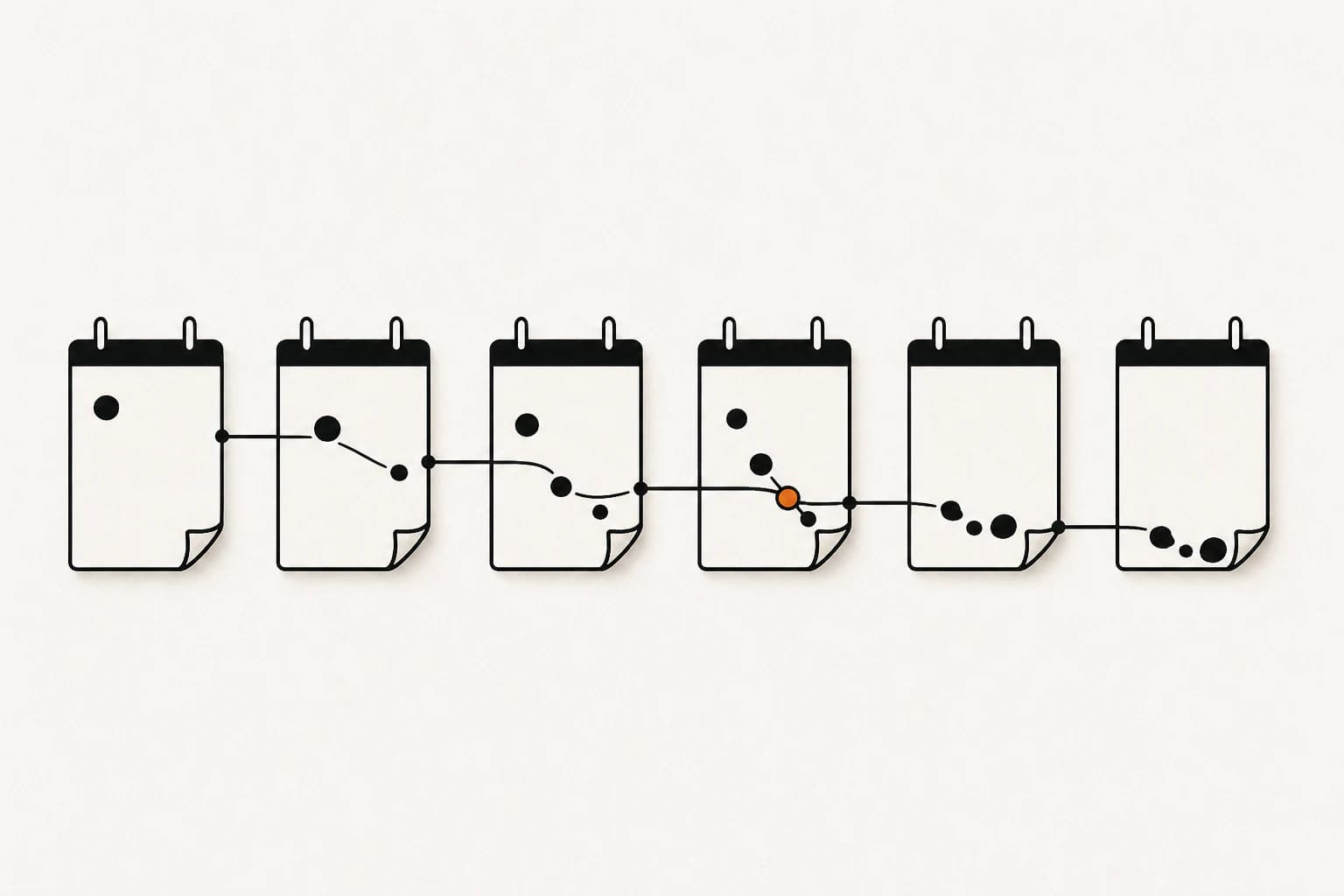
Enough Spots over enough months and you get a map: your patterns, linked to each other, with the strong connections drawn heavier. We call it the Constellation, and it needs about thirty days of Spots before it shows you anything honest. Building this is next year's problem, not this month's, and we would rather say so than mock up a graph that does not exist yet.
But the shape of the thing is clear. Nobody has ever handed you a map of your own patterns. Not the clinician who sees a narrow slice of your life. Not your wearable, which records signals but does not understand the surrounding day. Not you, because you are inside it.
Small things, multiplied by however many days#
The reason this matters more than it sounds like it should is that nothing in your health arrives as an event.
Nobody gets burnout on a Tuesday. They get slightly less sleep than they need, again and again, while the recovery slope drifts down at an angle too shallow to see day to day. Then everything becomes difficult and they cannot point at what caused it. Because nothing caused it. Everything caused it, slightly.
This runs in both directions, which is the more useful half. The rest days you felt guilty about last month produced the fastest recovery of your quarter. The afternoon walk you keep skipping when things get busy may be the thing that was holding the rest of the day together.
Compounding is invisible per unit and enormous over time. You cannot feel a slight drift. You can absolutely feel months of one.
What we do about it#
Waldo watches continuously and keeps what it learns. That is the entire difference. Each pass adds observations to a memory that persists, so today's data arrives beside what came before instead of arriving alone.
When something crosses the confidence bar it becomes a Spot and you get told only if it is actually new. Then Waldo acts on the ones that have an action. Your sharp window is in the morning, so that block gets held for the hard problem and the standup goes somewhere else. It tells you it did that, and why, in one line.
What it will not do is give you a daily insight, because there is not a real insight every day and manufacturing one is how you train someone to ignore you. Most days it has nothing new to say and says nothing.
You will keep re-explaining yourself to chat windows. That is fine, they are good at what they do. But something should be keeping the thread on the one thing you cannot restart from scratch, which is you.
The same Tuesday, repeating, is not bad luck. It is a pattern with your name on it.
Sources and basis
Waldo team
The team connecting individual Spots into patterns that remain understandable and correctable.